
There’s something steady about making jam. The slow bubbling, the gentle stirring, the way simple ingredients gradually turn into something rich and spreadable. Strawberry rhubarb jam brings together sweetness and a little tang, creating a balance that feels both familiar and just a bit different.
The Story & Emotional Connection
A recipe that slows things down
The first time I made strawberry rhubarb jam, I didn’t rush it. I stood by the stove, stirring now and then, watching the fruit soften and change. It wasn’t about getting it done quickly. It was about letting it happen.
That hour passed quietly, and by the end, the kitchen smelled warm and slightly sweet, like something worth waiting for.
Why this dish fits real life
Even though it takes time, this recipe doesn’t demand constant attention. It gives you space to move around, check in, and come back.
It’s also one of those things that keeps giving. A single batch can last for weeks, turning simple breakfasts or snacks into something a little more thoughtful.
What Makes This Recipe Work
A balance of sweet and tart
Strawberries bring a soft sweetness, while rhubarb adds a gentle sharpness that keeps the jam from feeling too sugary. The lemon juice brightens everything just enough to tie it all together.
As the mixture cooks down, the texture thickens naturally, creating that familiar jam consistency without needing anything complicated.
Why it feels dependable
Everything goes into one saucepan, and the process unfolds at a steady pace. You don’t need special techniques—just patience and a little attention.
Once it thickens and reaches the right temperature, you know it’s ready.
Making the Recipe at Home
Equipment
- Saucepan
- Instant-read thermometer
Ingredients
- 5 cups rhubarb (about 3 large stalks, cut into 1/2″ cubes)
- 2 cups hulled and halved strawberries (about 1 pint)
- 2 1/4 cups sugar
- 1 tablespoon fresh lemon juice (from about half of a large lemon)
Instructions
Combine all ingredients (5 cups rhubarb, 2 cups hulled and halved strawberries, 2 1/4 cups sugar, and 1 tablespoon fresh lemon juice) in a medium to large saucepan over medium heat. Once the mixture starts to bubble, reduce heat to medium low. You’ll want the heat set so it continues to bubble gently without splattering when stirred. Continue to cook, stirring occasionally, until the jam thickens. Plan on cooking for about an hour, until the temperature reaches over 220°F.
If you plan to refrigerate or freeze the jam:
Transfer the jam to clean glass mason jars. If refrigerated, it’s best used within 2 weeks. If freezing, leave enough space in the jar for expansion. It’s best enjoyed within 6 months, though it can last longer if needed.
If you plan to water bath can the jam:
While the jam cooks, sterilize four 1-cup jelly jars along with their lids and rings. You can do this by boiling them in water for 10 minutes or running the jars and rings through the dishwasher while boiling the lids separately.
Place the sterilized jars, lids, and bands on a clean towel. Prepare a large pot of boiling water deep enough so the filled jars will be covered by at least 1 inch of water.
Fill each jar with hot jam, leaving about 1/4 inch of space at the top. Place lids on and secure the bands until they are snug but not overly tight.
Carefully lower the jars into the boiling water and let them process for 10 minutes. Remove the jars and place them on a towel, spaced apart, and allow them to cool undisturbed for 24 hours. You should hear the lids seal shortly after removing them from the water.
If any jar doesn’t seal, or if you skip the canning process, store the jam in the fridge and use within 2 weeks. Properly sealed jars can be stored in a cool, dark place for up to a year.
Practical tips that actually help
Cut the rhubarb into evenly sized pieces so it cooks down at the same rate.
Keep the heat at a gentle bubble rather than a rapid boil. This helps the jam thicken without sticking or scorching.
Common mistakes to avoid
If the heat is too high, the mixture can splatter and cook unevenly. A steady, lower heat works better.
Also, don’t skip checking the temperature. Reaching the right point is what gives the jam its proper texture
Adapting the Recipe
Simple ways to change it up
You can adjust the sweetness slightly depending on your preference, though keeping close to the original balance helps maintain the texture.
For a smoother jam, you can mash the fruit more as it cooks.
Making it work for different situations
If you’re not ready to can, simply refrigerating or freezing works perfectly well.
If you’re making it as a gift, small jars make it feel thoughtful without much extra effort.
Serving & Enjoyment
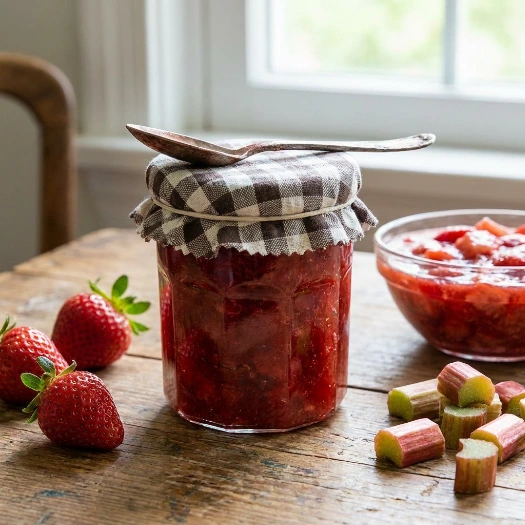
Spread it over toast in the morning, spoon it onto yogurt, or add a little to desserts. It brings a soft sweetness with a hint of tartness that keeps each bite interesting.
It’s one of those things that quietly improves whatever you pair it with.
Storage & Leftovers
Refrigerated jam should be used within 2 weeks. Frozen jam keeps well for several months when stored with enough space for expansion.
If properly sealed through canning, jars can be stored in a cool, dark place for up to a year. Once opened, keep it in the fridge.
FAQ
How do I know when the jam is thick enough?
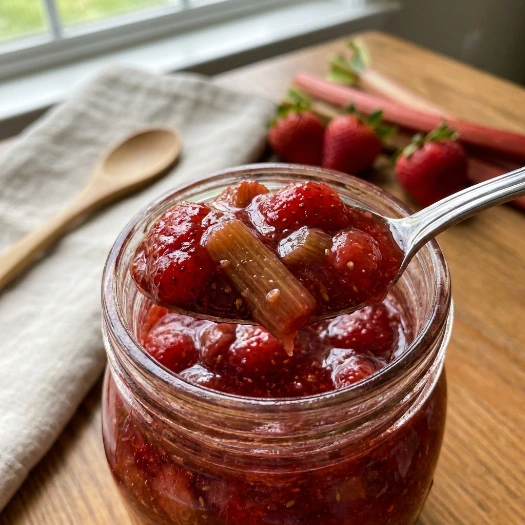
It should reach a temperature above 220°F and coat a spoon with a thicker consistency.
Can I skip the canning process?
Yes, you can store the jam in the fridge or freezer instead. Just follow the storage guidelines.
Why is my jam too runny?
It likely hasn’t cooked long enough or hasn’t reached the right temperature yet.
Can I reduce the sugar?
You can adjust it slightly, but too much reduction may affect how well the jam sets.
Conclusion
Strawberry rhubarb jam asks for a little time, but it gives something back in return. It turns a few simple ingredients into something that lasts, something you can reach for again and again.
There’s a quiet satisfaction in that—knowing you made it yourself, one slow stir at a time.

Strawberry Rhubarb Jam
Ingredients
Equipment
Method
- Combine all ingredients (5 cups rhubarb, 2 cups hulled and halved strawberries, 2 1/4 cups sugar, and 1 tablespoon fresh lemon juice) in a medium to large saucepan over medium heat. Once mixture starts to bubble, reduce heat to medium low. You’ll want the heat set to the point where it continues to bubble but not violently when stirred (you’ll understand once you start cooking if jam bubbles start to pop out of the center of the pot). Continue to cook, stirring occasionally, until the jam has thickened. Plan on cooking jam for about an hour and temperature of the mixture is over 220°F.
- If you plan to refrigerate or freeze the jam:
- Transfer jam to clean glass mason jars. If jam is refrigerated, it’s best if used within 2 weeks. If frozen, be sure to allow enough head room in the jar for expansion and it’s best enjoyed within 6 months but will keep even longer, if necessary.
- If you plan to water bath can the jam:
- While the jam is cooking, sterilize four 1-cup jelly glass jars plus their rings and lids. I do this by boiling them in water for 10 minutes or I boil the lids and run the rings and glass jars through the dishwasher.
- Transfer sterilized jars, lids, and bands to a clean dish towel.
- Have a very large covered pot of boiling water ready. There needs to be enough water in the pot so that when the filled jars are submerged, they’re covered by at least 1″ of water.
- Fill each jar with hot jam, leaving at least 1⁄4″ of space at the top. Place lids on jars, and secure ring bands. Secure just tight enough so that they are hand tightened but you can easily unscrew.
- Transfer filled jars to pot of gently boiling water and let boil for 10 minutes. Transfer jars, set at least 1″ apart, to a dish towel and let cool, undisturbed, for 24 hours. You should hear the seals on the lids pop pretty soon after removing from the water.
- If any jar is not fully sealed, or you chose to skip the canning process, jam should be refrigerated and used within 2 weeks. Sealed jars will keep, in a cool, dark place, for up to a year.
Notes
Calories: 61kcal | Carbohydrates: 15g | Potassium: 68mg | Sugar: 14g | Vitamin A: 20IU | Vitamin C: 7mg | Calcium: 18mg | Iron: 0.1mg