
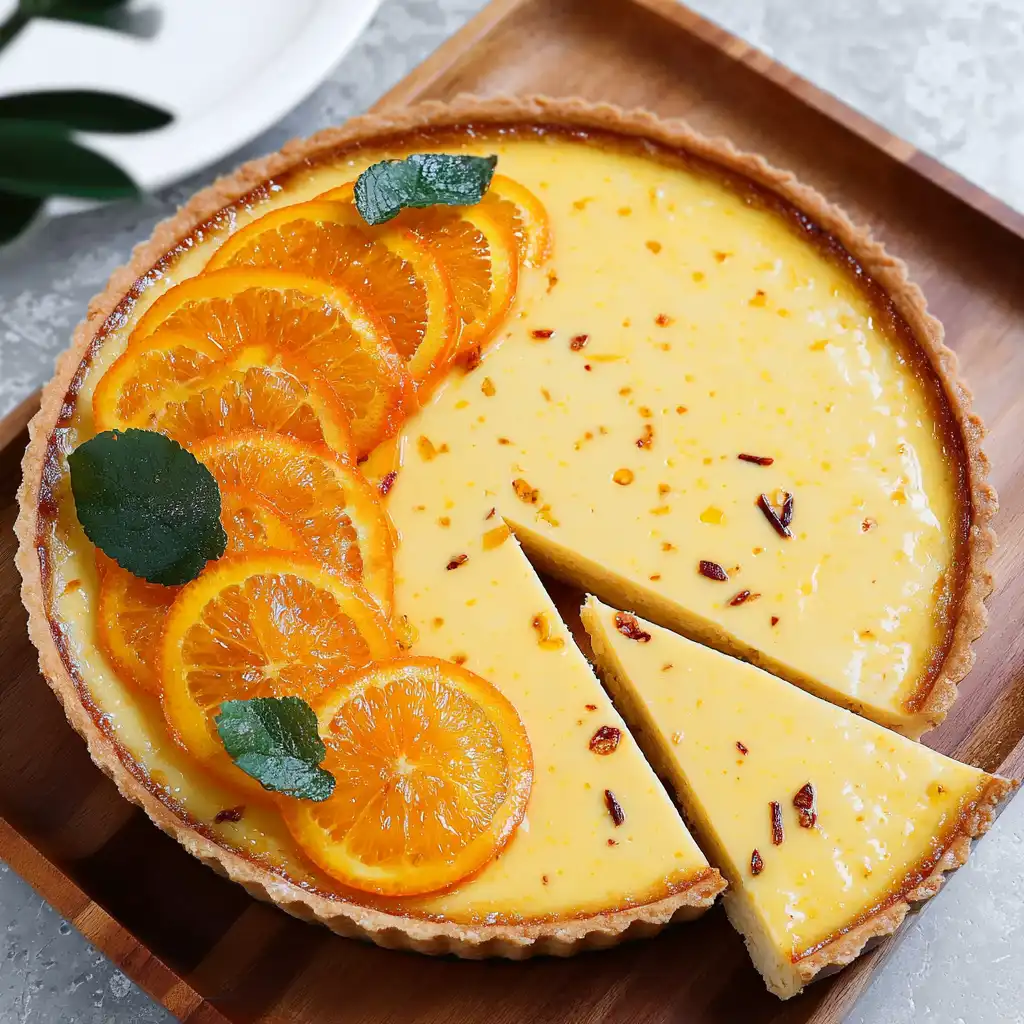
A French orange tart is a show-stopping dessert that combines the silkiness of citrus cream with the crisp bite of a sweet pastry shell. This classic recipe delivers rich, citrus flavor wrapped in a buttery crust. Whether you serve it at a brunch, dinner party, or simply as a weekend treat, it offers an elegant balance of texture and taste.
Let’s begin with the story behind this tart and what makes it so rewarding to bake.
The Story & Intro to the French Orange Tart
A tart for when you crave both comfort and elegance
The first time I made a French orange tart, I wasn’t sure what to expect. I’d made lemon tarts before, and while they were bright and sharp, they never quite had the warm depth I wanted from a citrus dessert. But oranges. Oranges have a sweeter perfume and softer acidity. When blended into a smooth cream and poured into a buttery crust, they deliver something closer to sunshine than dessert.
The kitchen filled with the scent of fresh zest and soft butter. I pressed the pastry gently into a tart ring, docked it with a fork, and waited as it turned golden in the oven. The real magic came with the orange curd. Silky, thickened slowly over heat, it shimmered as I stirred. Folding in butter made it lush, and once chilled, it set into a glossy filling that sliced cleanly and held its shape.
Serving that tart felt like revealing a little hidden jewel. One bite brought a burst of sweet orange followed by a gentle tang and the soft crunch of almond-rich pastry. It was everything I had hoped for simple, polished, and memorable.
Why make a French orange tart?
A French orange tart is less common than its lemon cousin, but that’s part of the charm. It stands out. The flavor is mellow yet complex, with a smoother finish that appeals to both citrus lovers and dessert purists. The tart looks elegant but doesn’t rely on tricky techniques. You make the pastry in one bowl. You whisk the curd by hand. You chill and serve.
It’s a dessert that rewards patience and care. From the gentle heating of the orange juice to the final swirl of butter into the cooled cream, each step adds a layer of richness and depth. And once you taste the result, you’ll understand why it’s worth every minute.
Coming up next, we’ll walk through the pastry and orange cream methods step by step to help you create a French orange tart that’s as beautiful as it is delicious.


French Orange Tart
Ingredients
Method
- Sweet Shortcrust Pastry
- Place the very soft Butter in the bowl of your mixer with the Powdered Sugar and mix together with the leaf/paddle attachment until smooth and creamy.
- On low speed, stir in the Egg then the Almond Meal and Orange Zest (optional). Scrap the edges of the bowl with a spatula if needed.
- Add the Plain Flour and Salt and mix it in on low speed until the dough comes together.
- Bring the pastry together into a ball then thinly roll between two sheets of baking paper (1). Place over a flat tray and put in the fridge to rest for at least an hour.
- Once the pastry has chilled, line your Pastry Ring or Tart Pan and dock the pastry (2). If baking straight away, place it in the freezer for at least 30 minutes then bake for 25 to 30 minutes in an oven pre-heated on 160’C / 325’F. Otherwise, keep in the fridge until ready to bake (3).
- Leave to cool down completely before adding the cream filling.
- Orange Cream
- Zest and Juice the Oranges. Set aside the Zest, and place the Juice in a Small Pot (4). Heat up the juice on the stove on low heat until it simmers.
- While the juice is heating up, whisk together the Eggs, Sugar and Cornstarch in a separate heat-proof bowl until smooth.
- Once the Juice starts to simmer, slowly pour it over the Eggs/Sugar/Cornstarch while whisking. Mix well until combined and smooth, then pour it all back into the Pot.
- Place the pot back on the stove on low heat and keep whisking until the liquid starts to thicken (5). Remove from the stove and transfer into a clean Jug or bowl.
- Optional: re-hydrate the gelatine powder with a little bit of cold water and whisk it into the cream until fully dissolved.
- Leave the cream to cool down (6) then add the soft Butter and Orange Zest. Quickly mix it in with an immersion blender (or with a whisk) until fully combined (7).
- Pour the Orange Cream over the fully baked Tart Crust and smooth it out with a small offset spatula if needed. Place in the fridge to set for at least 2 to 3 hours, or up to 24 hours before serving.
- Optional: cut out small segments of fresh orange to garnish the tart before serving.
Notes
For more information, step by step photos, tips and tricks on the Sweet Pastry Shell, read my Sweet Shortcrust Pastry recipe.
Yield: I used a 25 cm / 10 inch Tart Ring. Instruction Notes:
- I rolled the pastry to be about 4mm / 0.15 inch.
- To “dock” pastry means pricking it to avoid the formation of air bubbles. Simply use a fork and prick the whole bottom of the pastry, making sure the small holes go all the way through the pastry.
- I kept my lined tart ring in the fridge overnight, then placed it in the freezer while my over was pre-heating the next morning. The pastry needs to be very cold to avoid moving or shrinking in the oven.
- Pour through a thin mesh sieve to remove any pulp if preferred.
- It could take a few minutes on low heat. Make sure the heat is not too high or it might cook the eggs and curd. To make sure the eggs are fully cooked, whisk until you get a boil.
- Ideally, it should be around 40’C / 105’F before you add the Butter. If the cream is too warm, the butter will melt straight away and potentially split from the cream.
- It will only need a few seconds with an immersion blender – make sure not to over-mix it or it will turn liquid again. You can use a whisk if you do not have an immersion blender, but will need to stir it well to create an emulsion.
Making the Sweet Shortcrust and Orange Cream
Crafting a buttery tart shell that holds its shape
The tart starts with a classic sweet shortcrust pastry. This dough is rich with butter and almond meal, giving it a crisp yet tender texture that complements the smooth orange cream. Begin with very soft butter in your stand mixer. Use the paddle attachment to mix it with powdered sugar until creamy. This creates the base of a delicate, flavorful dough.
Add one egg, then blend in almond meal and optional orange zest for a gentle citrus note. Once the mixture is smooth, add the flour and salt. Mix on low speed until it just comes together. Avoid overmixing to keep the pastry tender.
Shape the dough into a flat disc and roll it between two sheets of baking paper. This prevents sticking and keeps the dough even. Transfer it to a tray and chill for at least one hour. Cold dough is easier to handle and bakes without shrinking.
After chilling, line your tart pan or ring with the dough. Dock the bottom with a fork to prevent bubbles. If baking right away, freeze it for 30 minutes to help the shell hold its shape. Bake at 160°C (325°F) for 25 to 30 minutes until golden and firm. Let it cool completely before adding the filling.
Silky orange cream: the heart of the tart
To make the orange cream, zest and juice three large oranges. You should get about 300 ml or 1¼ cups of juice. Gently heat the juice in a small pot over low heat until it begins to simmer.
In a separate bowl, whisk together the eggs, sugar, and cornstarch until smooth. Slowly pour the hot juice into this mixture while whisking constantly. This step tempers the eggs, preventing them from curdling.
Return the mixture to the pot and place it back over low heat. Whisk until it thickens into a smooth curd. Once thick, remove from heat. Optional: for added stability, you can whisk in hydrated gelatin at this stage.
Let the cream cool slightly. When it reaches about 40°C (104°F), add soft butter and orange zest. Use an immersion blender or whisk to combine everything into a glossy, rich filling.
Pour the cream into the cooled tart shell and smooth the top. Chill in the fridge for 2 to 3 hours, or overnight if you have time. This gives the tart time to set and the flavors time to develop.
In the next section, we’ll explore flavor options, garnishing ideas, and how to get the perfect texture every time.
Finishing Touches, Texture Tips, and Serving Suggestions
How to perfect the texture and get a clean slice
One of the most satisfying parts of making a French orange tart is slicing into it and revealing that smooth, glossy filling. To get the best results, make sure your orange cream cools to the right temperature before adding the butter. If the cream is too hot, the butter will melt instantly and may separate, leaving the filling greasy instead of silky.
Use an immersion blender if you have one. It emulsifies the cream and butter quickly without overmixing. If you’re using a whisk, stir just until the mixture is uniform and glossy. Over-whisking can break the emulsion and thin the cream too much. The ideal texture is thick and pourable, not runny.
Once the tart is filled and chilled, run a sharp knife under hot water before slicing. Wipe it clean between cuts for tidy, smooth edges. The cream should hold its shape while still looking soft and luxurious.
Elegant garnishes and when to serve it
To finish your tart, you can keep it simple or dress it up. A classic choice is to arrange small segments of fresh orange on top. Use a sharp knife to cut away the peel and pith, then slice clean segments from the membrane. Lay them gently on the surface of the chilled tart just before serving.
Another option is a dusting of powdered sugar or a few candied orange peels. You could even glaze the top with a thin layer of warmed apricot jam for a shiny finish. Just make sure the cream has fully set before adding anything on top.
As for serving, a French orange tart is best chilled. It needs at least two to three hours in the fridge, though overnight is ideal. This gives the filling time to firm up and the flavors to meld. Serve it directly from the refrigerator, either plain or with a dollop of whipped cream.
In the next and final section, we’ll answer common questions about orange tarts and provide quick tips to help your tart shine every time.
FAQs and Final Tips for French Orange Tart Success
What is a French orange tart called?
In France, a traditional orange tart is known as tarte à l’orange. It belongs to the same family as tarte au citron but uses oranges for a softer, less tart citrus flavor. These tarts are often seen in patisseries alongside lemon and fruit tarts. Their smooth curd, buttery base, and polished presentation make them a refined choice for any occasion.
Can I use regular oranges for orange tart?
Yes. Standard sweet oranges like navels or valencias work beautifully. The key is to use fresh, juicy oranges with bright, fragrant zest. Avoid varieties that are too sour or dry. If you prefer a deeper flavor, you can combine orange juice with a splash of blood orange or even a little mandarin for variation. Always taste the juice before using to ensure it’s balanced.
How do you thicken orange curd for tart filling?
Orange curd thickens with a combination of eggs and cornstarch. The eggs provide body, while the cornstarch stabilizes the mixture and prevents separation. The curd must be cooked slowly over low heat and stirred constantly. This ensures it thickens without curdling. Once cooled slightly, butter is added for richness and a creamy finish. For extra firmness, you can dissolve a small amount of gelatin and mix it in after cooking.
Should orange tart be served cold or warm?
French orange tart should always be served cold. Chilling allows the cream to set properly and gives the tart a clean, structured texture. Serving it warm would make the filling too soft and the crust more prone to crumbling. For best results, refrigerate the tart for at least two hours before slicing and serve straight from the fridge.
Conclusion
A French orange tart is a dessert that rewards care and patience. With a crisp almond pastry base and smooth orange curd filling, it offers a bright, balanced flavor that’s both classic and comforting. Each step, from mixing the dough to blending in butter, adds richness and polish to the final tart. Whether you serve it for a celebration or a quiet Sunday lunch, it’s the kind of dessert that leaves a lasting impression.